


Conservatism and Freedom: A Libertarian Comment
This essay appeared in Modern Age, 5, 2 (Spring 1961), pp. 217-220.
Modern Age is to be warmly congratulated for its articles on "Conservatism and Freedom" in the Fall, 1960 issue. Certainly, there is no more important intellectual task than launching a dialogue toward a synthesis of the two most important intellectual currents on the American "Right" today: the conservative and the libertarian. Modern Age can make, and has begun to make, a notable contribution toward that dialogue. As a libertarian, I have been aware for some time of the importance, not only of converting authoritarian conservatives to the cause of freedom, but also of convincing the libertarians of the great importance of recognizing the existence of an objective moral order. As both Messrs. Meyer and Evans point out, there can be no truly moral choice unless that choice is made in freedom; similarly, there can be no really firmly grounded and consistent defense of freedom unless that defense is rooted in moral principle. In concentrating on the ends of choice, the conservative, by neglecting the conditions of choice, loses that very morality of conduct with which he is so concerned. And the libertarian, by concentrating only on the means, or conditions, of choice and ignoring the ends, throws away an essential moral defense of his own position.
I was particularly impressed by Frank Meyer's admirable article. I pass over reluctantly the temptation to quote extensively from his essay. I don’t think there is anyone in the “conservative” camp who has as great an understanding of, or sympathy with, the libertarian, or “classical liberal” tradition. In contrast to Mr. [M. Stanton] Evans, for example, who chides the libertarian for believing that liberty is the highest moral end for man, Meyer sees that the best libertarians have realized, with Lord Acton, that liberty is the highest political end, i.e., the highest end that is proper for government, the organized arm of coercion, to achieve. I am a devoted adherent of a large part of the Aristotelian-Thomist philosophical tradition; but one part of that tradition has been politically disastrous for the West: the Greek notion that the State is somehow the most important ethical institution in society, and that therefore what is good for men to pursue is automatically good for the State to pursue. There, I believe, is the critical error of the authoritarian conservative creed, of the old-style “natural law” tradition before its proper corrective in the individualist, natural rights variant of that tradition as coined in the seventeenth and eighteenth centuries.
Here, perhaps, is the gravest failure of the Meyer and Evans articles: the failure to distinguish, in discussing classical liberalism, between the eighteenth and the nineteenth century versions of that creed. Their strictures apply, and properly so, to the nineteenth century version, which, admittedly, is much more common today: Benthamite, utilitarian. even positivistic – a version particularly prevalent among neo-classical economists. It is this wing of liberalism that has been remiss in recognizing objective moral values. The older seventeenth and eighteenth century version, however, was quite different: it believed staunchly in an objective moral order of natural laws, discoverable by man’s reason; and, as part of that moral order, it discovered the importance of individualism and the natural rights of person and property as the proper political end. It therefore worked, though often unwittingly, within the Thomist natural law tradition of the West, adding a full libertarianism to that tradition. Whether or not the older libertarians were Christians theologically, they were certainly Christians philosophically. Neither Meyer nor Evans, therefore, do proper justice to those libertarians of the Enlightenment who have, in a sense, already anticipated our dialogue and our synthesis.
Aside from this general caveat, I have only a few minor criticisms of Mr. Meyer’s article. Meyer recognizes the primacy of reason, and realizes that simple reliance on tradition is an impossible task. Because of the infinite number of historical traditions handed down to us, we must select and choose; and our only weapon in this selection is our reason. And yet, despite his basic recognition of the primacy of reason, Meyer leans too far over on the “conservative” side of this dialogue by emphasizing that reason must operate “within tradition,” and not in any sort of “ideological hubris… ignoring the accumulated wisdom of mankind.” Now when Mr. Meyer recognizes that the conservatives must employ reason to select between true and false traditions, he has placed himself above and not within tradition, and necessarily so. A man cannot be within something, and yet judge it from all outside standard. Here I think Meyer has fallen for what is essentially a straw man version of the libertarian, rationalist creed. Every intelligent rationalist recognizes the great value of studying past thinkers and past accumulations of knowledge: for no man is omniscient, and therefore it is an enormous time saver and gain in efficiency, knowledge and clarity, to build on the best writings of the past, instead of trying to spin out all the laws of the universe de novo, which is to act as a savage with no inherited record of civilization to help a man on his path to knowledge and wisdom, While modern historicists and relativists scoff at such accumulated wisdom, certainly no genuine rationalist libertarian will do so. But to say this does not give up the supremacy of reason – quite the contrary.
My only other quarrel with Mr. Meyer is his fondness for the term “tension” to describe the proper balance between freedom and value; tension implies a precariousness and an underlying contradiction which I don’t think exist. Properly developed, the relationship between freedom and ethics is a peaceful and cohesive harmony, a harmony of a unified natural law, rather than a precarious tension. In the political sphere, that harmony comes about through the confinement of the coercive arm of society to the defense of individual rights of property.
With Mr. Evans, on the other hand, my differences are much more serious. I have already mentioned his confusion of political ends with general moral ends. He also erects a false dichotomy in believing that the libertarian wants freedom because he believes man is naturally good and should therefore be turned loose, while the conservative wants freedom because he realizes that men can be bad, and therefore wants to limit potentialities or evil in society. This, too, is a straw man. Rousseau believed that man is naturally good, corrupted by his institutions; but only a few libertarians in the past have believed this, and I myself have yet to meet a libertarian who holds to such a puerile absurdity. All libertarians whom I have met believe, as all sensible men do, that man is a mixture or good and evil: that he is capable or both types of actions, given his free will to choose. The libertarian wants, simply, to create such institutions in society that will maximize the channels, the inducements, for doing good, and to minimize the opportunities to do bad. We want freedom from the State because the State is the only legal, and by far the most powerful, channel for committing evil in society; and because, having freedom, man can exercise his opportunity to perform good actions. The positive and the negative, the freeing of the good and the checking of the bad, are two sides to the same libertarian coin. The same applies, incidentally, to the much abused “philosophical anarchist” variant of the libertarian creed: no philosophical anarchist worth his salt believes any longer in man’s “natural goodness.” Viewing the State as the legal engine for crime and evil, he wishes to abolish it, and to substitute various other forms of defense of the property rights of the individual. The real question that the anarchist poses, and that no one has really tried to answer, is this: is the State the only, or the most efficient, possible instrument for defending the rights of person and property in society?
We come now to Mr. Evans’ apotheosis of James Madison and the Constitution. Belonging roughly to the Jeffersonian wing of the inner debate of the Founding Fathers, I regard Madison as a weak trimmer and fuzzy compromiser, rather than a sagacious combiner. Without the unnecessary Madisonian concessions to the profoundly statist programs and conceptions of Hamilton, the Constitution would have been a far more libertarian and a far more lasting instrument than it has proved to be. But there is more involved here: for Mr. Evans, despite the black record of the present century, persists in believing that the American Constitution has succeeded gloriously in its mission. From any libertarian, or even conservative, point of view, it has failed and failed abysmally; for let us never forget that every one of the despotic incursions on man’s rights in this century, before, during and after the New Deal, have received the official stamp of Constitutional blessing. The Constitution has been stretched a very long way. If Mr. Evans should reply that these tyrannical acts have been really, and in the strict sense, unconstitutional, I would hasten to agree.
But that is my whole point: that the instruments set up by the Constitution – in particular, the erection of a monopoly Supreme Court with the final power to decide what is Constitutional – embody a fatal flaw in any constitutional attempt to limit the State. In short, when you give the State itself the final power to interpret the very instrument that is supposed to limit the State, you will inevitably find the Constitution being stretched and distorted, until it becomes merely a means of lending an unjustified aura of prestige to the State’s despotic actions.
Calhoun, one of the great political thinkers in American history, went to the heart of the matter when he criticized the common reliance on a written constitution restricting government power:
"…It is a great mistake to suppose that the mere insertion of provisions to restrict and limit the powers of government. without investing those for whose protection they are inserted with the means of enforcing their observance, will be sufficient to prevent the major and dominant party from abusing its powers. Being the party in possession of the government, they will, from the same constitution of man which makes government necessary to protect society, be in favor of the powers granted by the constitution and opposed to the restrictions intended to limit them. ..of what possible avail could the strict construction of the minor party be, against the liberal interpretation of the major, when the one would have all the powers of the government to carry its construction into effect and the other be deprived of all means of enforcing its construction…."1
The Constitution, in short, was a noble attempt to solve the problem of restricting government to its proper sphere; but it was a noble attempt that failed, and therefore we must begin to search for more stringent and effective measures.
Two final comments on the conceptions of conservatism and classical liberalism, In the first place, I do not like the term “conservative,” nor does any other libertarian. This term stands in the way of a constructive synthesis, for it implies not only the “natural conservatism” mentioned by Frank Meyer – the blind and tropistic defense of whatever status quo happens to exist – but also, more seriously, it carries with it the conservative position of the nineteenth century, when conservatism was born. For nineteenth century Conservatism, far from criticizing the Benthamites from the old natural rights point of view, was essentially a reaction against all that liberalism stood for: in particular, individual freedom, and the economic freedom that produced capitalism and the Industrial Revolution. The Conservative Party of Prussia, the first effective conservative grouping, was expressly formed to defend the institution of serfdom threatened by the rising influence of freedom and free enterprise. The irrationalist, organicist, and étatist biases of Conservatism all fed and influenced the supposedly anticonservative socialists of the nineteenth century. Even today, there is in the concept of “conservatism” an atmosphere redolent of Throne-and-Altar which has no place in any desirable “Rightist” synthesis, To put it bluntly and concretely, I would say to the conservatives, we libertarians will give up Bentham if you will give up the Crown of St. Stephen,
And, lastly, having indicated the neglected strengths of the classical liberal tradition, I must indicate some of the weaknesses of that tradition, even in its enormously superior eighteenth century version. The chief defects of Enlightenment liberalism, I believe, are these: an inordinate passion for democracy, and an inordinate hatred for institutional religion, particularly for the Roman Catholic Church. The true liberal should place foremost, in judging government, the policies that that government pursues; who runs the government is of secondary, purely instrumental importance, Of course, all other things being equal, it would be nice to have democratic voting ratify libertarian policies, but this is of minor importance. Democracy is simply a process, and once elevated into an end-in-itself, it becomes a potentially mighty engine for mass tyranny and popular collectivism. Furthermore, democracy, by encouraging the idea of equal voting by all men, grants the vote before it is properly earned and therefore fosters an excessive and dangerous egalitarian tendency in society.
The intense hatred of the Enlightenment for the Catholic Church was a tragic thing; for it severed, on both sides, two traditions which really had a great deal in common, and set these two mighty forces at almost permanent odds. This hatred pushed the Enlightenment liberals into numerous and grave anti-libertarian measures to oppress the Church: confiscation of church property, outlawing of monasteries and the Jesuit order, nationalization of the Church, and, perhaps the gravest of all, the erection of a system of public schools. For the establishment of public schools makes the grand concession, the concession that education of the young, one of the most important functions of society, is properly to be conducted by the coercive State. And if schools, why not other educational media, why not radio and television and newspapers, and why not, indeed, every other social good and service? The very existence of the public school – even if Americanism groups see to it that its textbooks are not tainted with socialism – cries aloud to its little charges the virtue and sanctity of government ownership and operation, and therefore, of socialism.
The libertarian, then, in building upon the older classical liberal tradition, must not only abandon utilitarianism and positivism: he must also abandon that tendency toward a worship of democracy and an unreasoning hatred of Catholicism that led him, among other flaws, to the erection of a vast incubus of statism and tyranny, the public school. And in doing so, he will also take a long step forward toward that very synthesis of the Right-wing Weltanschauung that we all recognize as so important in the present-day world.
Note
- John C. Calhoun, A Disquisition On Government (The Liberal Arts Press, 1953), pp. 25 ff.
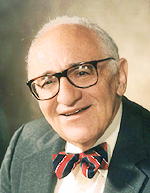 Murray N. Rothbard (1926-1995), the founder of modern libertarianism and the dean of the Austrian School of economics, was the author of The Ethics of Liberty and For a New Liberty and many other books and articles. He was also academic vice president of the Ludwig von Mises Institute and the Center for Libertarian Studies, and the editor – with Lew Rockwell – of The Rothbard-Rockwell Report.


