


Cool & Strange Music Vol. 2, Number 8
October 8, 2005
 Okay, now I’ve had it. My last few Cool & Strange Music articles got me blasted by a bunch of readers with comments like:
"Strange? Yes. Cool? No."
"Definitely not cool. How about the new album by Bon Jovi? Now, that’s some hot music."
"Since when did you stop Rock’n’Rollin’ and start on the adult diapers?"
Yes. Yes, how amusing. How very droll, indeed. But that Bon Jovi comment has just about got to be the bottom of the barrel. Bon Jovi? I have never bought a single Bon Jovi recording in my life. In fact, I’ve never even listened all they way through a Bon Jovi song to the end. Although I have noticed a few LRCr’s recently actually having the guts to admit listening to, er, "rock classics," like the Eagles, Foreigner, or Journey — Yeech! I have a hint for you folks, if you want to stay cool, you won’t admit listening to that — to put it mildly — commercial pabulum (ahem) to anyone. Oh, and hide those CD’s when friends that you wish to impress might want to come over. Those bands are not cool; they never were cool; they never will be cool; and they are about as un-cool as they can get — and that’s pretty bad. So keep it under your hats. It’s one thing to promote individuality and Austrian economics and self-government — so good so far — but it seems a tad bit ridiculous if while doing so, you’re damaging your brain listening to the Hit Parade of Hades. Well that is, unless of course, you are listening to some great rock with cool lyrics like this:
Wake up in time to see the sun going down Turn on the six o’clock news See what’s happening in this town I take a walk down to the corner I meet those bad girls hanging around Never doing what they oughta
Ooh yeah, I get caught up in the action Gotta find the main attraction now Gotta get some satisfaction You better take me to the heart of that…
Let’s see here: Down, town, around…. Action, satisfaction, that… Well at least it rhymes in a sideway sort of manner. Anyhow, that’ll be enough of that — we immediately terminate the stereo with extreme prejudice — and get back to the cool music. (By the way, if you know the name of the above song and artist who "performed" it, write to me and I’ll never speak to you again.)
But what am I if not a delicate (but strict) teacher to you, the gentle reader who wishes to become knowledgeable in coolness? I’ve been saving the best for last but since getting hammered by readers over the last several issues of this column, the kid gloves come off now.
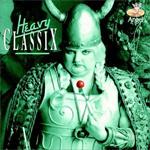 Heavy Classix — Various Artists $10.98
Okay, here’s the scene: You and your friends are out on an anti-stately evening enjoying the panoramic view of the city lights and wish to take in an evening of fine wine and song when some huge black Dodge van pulls up at the red signal blasting away the latest by Heavy Metal band, The Long-Haired Screaming Headless Torture Chickens. The guy driving the van looks like some Hippie from some 1970’s made-for-TV movie. He’s got a long beard, the requisite "Mom" tattoo, and looks like he hasn’t washed his hair or brushed his teeth in weeks. Next to him, sits his "old-lady" who looks tough enough kick all of our derrieres by herself — with one hand tied behind her back. The lead vocalist is screaming out some Death-Metal from Dantes and Mr. Hippie turns the volume knob just up a tad to eleven as they pull next to your just washed car.
The noise screams in from the window like an F-16. You look out and have eye contact with the savage and he gloats, gold front tooth glinting in the light. What to do? Well, to roll up your window and ignore him would not be a very neighborly thing to do, now would it? What would Miss Manners do in this case? I know. Miss Manners would gently remove this CD from the casing, insert it into yon CD deck, and put the volume on full blast while lightly opening her window giving our long-haired friend a hellacious blast of Wagner. Trust me. They won’t know what hit them!
You see, dear reader, you must understand the beast if you wish to tame him. Most of these metal-heads think that a four-piece band with Marshall amplifiers stacked to the ceiling can roar (no doubt they can) but nothing can roar like a full ensemble symphony orchestra. Where do you think these heavy metal bands get their inspiration in the first place?
This is the best collection of invigorating symphony classics ever assembled. Whether for driving a car, a brisk morning eye-opener, or an unforgettable evening about town; this CD is for you. 15 classics of the classics from Wagner to Tchaikovsky, Stravinsky to Borodin; you get these greats, The Valkyrie; 1812 Overture; The Damnation of Faust; The Planets; Symphonie No. 1 In D "Titan"; The Firebird; and many more! You must have this CD.
 Tone Poems — Tony Rice & David Grisman Sale Price: $14.99
Sometimes readers write to me and challenge me to tell them what kind of music I really listen to — I mean really listen to for my pleasure and relaxation. Well, I often like Perrey Kingsley, but when I’m not in the mood for that or classical music, then I am in the mood for some real musicianship and some fantastic sound quality. Tone Poems is that music.
This is the perfect album for relaxing on a Sunday morning. Imagine yourself on a beautiful summer beach without a care in the world. Throw in a few drinks and a barbeque cracklin’ nearby and you can just smell the relaxation with this CD. Rice and Grisman are the tops in their fields when it comes to modern guitar and mandolin collecting and playing. The instruments used on this album are the originals — models built around the turn of the 20th century — and do they ever sound amazing. The tuning for instruments of that time is different than what is the standard today and it comes out in the most beautiful music that this album features. And what better musicians to play those instruments than these two guys?
I dare anyone who loves beautiful music and the nostalgia of the old days to give this album one listen and not tell me that this is one of the finest CDs ever made.
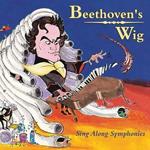 Beethoven’s Wig: Sing Along Symphonies Sale Price: $11.99
About 25, 30-some odd years ago, someone wrote a book that spoke about the problems of modern-day parenthood. The main idea of the book boiled down to: If you don’t have quantity time to spend with your kids, spend quality time. This idea was all well and good, but it is wrong. The problem is, from a child’s eyes, all time spent with a parent is quality time — it doesn’t matter what you are doing together. Parents (especially American dad’s) mistook this idea as a way to allow them and be lazy in regards to their child. It allowed them to rationalize the notion that they could get off the hook of spending real time with their kid by spending money on the little time they did spend together. Nonsense. Quality time does not mean relieving your laziness and guilt by spending a bunch of money by allowing your kids to run amok at Aquarium World on the weekends. Read a book to your child every night; sing songs with them. Now that’s quality time.
To prove that I am right and the creator of this quality over quantity idea when it comes to raising children is wrong, comes with just a look around you.
And don’t think your child doesn’t want to do that or you don’t have energy for it. Heck, most 1-year-old kids will get bored after 15 to 20 minutes of book reading, so just do it. And when you don’t have hands free to read a book, put on this CD and sing along with your kid.
 Beethoven’s Wig, Vol. 2: More Sing-Along Symphonies Sale Price: $11.99
Look at that dumb kid. Would you just look at ’em? You know who I mean — the neighbor’s brat. Do you want your kid winding up like that? I didn’t think so. What a dumb kid. If your kid is between 1 month old to 2 years, do yourselves a favor and pick up this CD too while you’re buying Beethoven’s Wig. The liner notes on these CD’s speak for themselves:
Beethoven’s Wig Sing Along Symphonies are zany stick-in-your-head lyrics set to the greatest hits of classical music. Filled with fact and fancy about the world’s most notable composers and their masterpieces, each Sing Along Symphony opens the door to "serious music" in a way that’s fun. As a bonus, the orchestral performance of each classical piece is included without lyrics.
Sure this is a bit dorky music. But all mild mannered and intelligent kids are dorky outsiders nowadays. Buy both of these CDs. If you have kids, or know someone who does, in a few years you’ll all be glad you did.
 Thomas the Tank Engine: The Complete Collection (Railway Series) (Hardcover) — W. Awdry Super Sale Price: $24.99 (Regular Price: $124.00!)
Now that we are talking about spending time with your kids and raising them not to be morons, I’m going to brag about my son. Thanks to some wonderful advice from Linda Shrock Taylor (as well as shutting up when my wife decides something) I am proud to announce that my son could sing the entire ABC Song — as well as say the individual letters in a random order — and speak sentences when he was only 18 months old. Not only that, he now can read the entire Japanese Hiragana alphabet (50 letters) at 1 year and 10 months old… None of his friends, even ones who are 6 months older than him can, do that.
His friends all are still stuck with saying one word like, "Mama," etc. But my son says stuff like "Let’s go to the park." As one of my Japanese friends who graduated from London University said when he witnessed for himself my son’s ability, "That’s almost frightening."
How did this happen? How can you help your child or a loved one’s child do the same? I think I know the answer. I wrote to Linda Schrock Taylor to ask for some advice on what kinds of books to read to 6-month-old children. Linda actually wrote back to me and recommended "series" types of books. She said, "Small children just love repetition." And was she ever right on the money with that advice!
 Thomas The Tank Engine And Friends — The Early Years (3-Disc Set) Sale Price: $31.98
We started our son on Baby Signs from about 3 months old. Then I went to reading simple books to him from 6 months old. The times my hands weren’t free (like when I was washing dishes or whatever) I allowed my son to only watch videos — No TV! The video that we started off with was — the logical choice considering Linda’s advice — Thomas The Tank Engine. I chose this particular DVD because I am a huge fan of Richard Starkey (Also known as Ringo Starr). The later versions of Thomas are good too as they feature either George Carlin or Alec Baldwin but, being an oldie, I like the originals best, so I stuck with Ringo. I think it’s also a plus to have your child hearing proper English with a proper accent that sounds, how do you say? Refined.
 Thomas is to kids today what Mickey Mouse was to us. Check it out and you’ll be amazed at the magical attraction Thomas has with your youngster.
Thomas The Tank Engine: All Aboard With Thomas! (Comes with a toy, too!) — Various Artists Sale Price: $24.49
Then, a few months later, when your child is old enough to understand and to play by themselves without screaming that mommy is not around (about 8 months), throw this CD on and watch your child as they start to sing along by themselves and learn to speak.
You’ll find yourself singing along too as the songs are all wonderful and very catchy. Some of the songs I’ve thought that some big British rock band should cover. They are just that good.
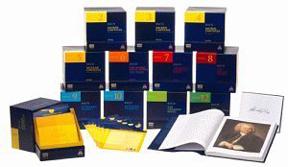 Bach 2000: The Complete Bach Edition (Includes Commemorative Book) (Box Set) List Price: $1,199.98
Oh my God! Would you look at this box set? A thousand dollars, and then some, for a 153-CD box set? Let’s see, that works out to about $7.83 per CD (a good deal) but still, that’s a mighty impressive collection. Wow! Someone must really — or know someone who really — likes Bach to buy this! I guess I’d only buy this for someone I really cared for and only for an unforgettable Christmas present.
Let’s check it out and see what Amazon has to say (and they’d better have a lot to say about this ultra-amazing CD collection):
The Bach renaissance — which began in earnest in the early 19th century thanks to the efforts of Felix Mendelssohn and others — inspired an endeavor of far-reaching significance. It led to the founding of the Bach Society in 1850, with the goal of gathering and publishing the composer’s complete works, and thus set into motion one of the great projects of musical scholarship. That effort has continued and been refined throughout the 20th century, ultimately influencing not only our perception of how to perform early music but fundamental ideas of musical history, evolution, and reception as well.
Teldec’s mammoth Bach 2000 box set represents a kind of culmination of that original attempt to come to terms with Johann Sebastian Bach’s unparalleled legacy. This set brings together performances recorded over the last several decades — a small percentage of the recordings are previously unreleased — of all the extant works determined by modern scholarship to be authentic. There are also some pieces the authorship of which is still in question and a few now deemed “inauthentic” but familiarly associated with the composer. Bach was a prodigious reviser of his compositions, and alternate versions of a particular work have been included “where the changes seemed sufficiently important,” such as the glorious Magnificat. No doubt manuscripts will continue to be unearthed here and there in various archives (Bach 2000 contains, for example, the “Neumeister chorales,” which were rediscovered in 1984), but the set does not represent the many fragments of music that consist of just a few bars; however, there are some reconstructions of lost concertos (such as one for three violins reconstructed by Christopher Hogwood from an extant concerto for harpsichords).
Of course a truly comprehensive recorded edition of every note Bach wrote remains a utopian impossibility — about one-third of his cantatas, for example, have not survived. Even so, the dimensions of Bach 2000 are staggering. With its 12 boxes comprising 153 CDs, the set can be compressed into fewer boxes to save shelf space yet is still about ten times as long as the Ring cycle. (It should be noted that the packaging — using thin cardboard sleeves for the CDs — is distinctively unattractive.) That adds up to just under 160 hours of music — but a lifetime of discovery. Each box (grouped according to genre) contains a booklet with excellent notes on individual works and — for all the choral works — texts and translations. Tracking indexes are useful and thorough. Also included is a profusely illustrated hardbound volume of 24 Inventions, in which journalist Wolfgang Sandberger uses the composer’s biography as a peg for some enigmatic and fascinating musings on the meaning of Bach today.
The presiding philosophy behind this project and its approach to musical interpretation can be largely ascribed to Nikolaus Harnoncourt, a true musical pioneer and galvanizing force of the “period performance” movement. Harnoncourt’s epoch-making recordings of the sacred cantatas (using, for instance, boy sopranos and choristers according to the practice in Bach’s time) with the Concentus musicus Wien and colleague Gustav Leonhardt comprise the first four volumes here (those who already own them can turn to the Bach 2000 Light edition, which contains everything sans the cantatas). These recordings — which were not remastered for this set — have long been controversial and are notably uneven, embracing some magnificent accounts as well as others that lack fire and seem clearly underrehearsed. But Harnoncourt is one of the most fascinating conductors of our era, and his interpretations amply bear out his assertion: “I have never felt that Bach worked in a routine manner, that he repeated himself in his works.” Harnoncourt — who has articulated many of his ideas in his book The Musical Dialogue — displays his gifts as a cellist in a remarkably probing performance of the Cello Suites (originally recorded in 1965) and in his concertizing for a number of chamber works. For the St. Matthew Passion, you get Harnoncourt’s groundbreaking earlier account from 1970, while his 1986 recording of the sublime B Minor Mass is also represented here (the St. John Passion included is Harnoncourt’s 1995 account).
Other artists included are colleague Gustav Leonhardt, whose thoughtful if occasionally dry harpsichord artistry is heard in the Goldberg Variations as well as in the concertos and chamber music. The harpsichord is in fact used throughout in preference to piano for the keyboard works. Ton Koopman (himself the conductor of an ongoing complete cantata series and of the Easter Oratorio included here) performs the organ works, including some newly recorded offerings, while Il Giardino Armonico’s well-known high-energy account represents the Brandenburg Concertos. Violinist Thomas Zehetmair is exceptionally compelling in the unaccompanied sonatas and partitas, and the Concentus musicus Wien — again under Harnoncourt — perform a superb Musical Offering that richly repays frequent listening.
The result of Bach 2000 as a whole is an aptly encyclopedic grappling with the infinite legacy of this most compendious of composers, whose works are on one level a summation of all the styles available to him. Bach was once thought to represent a “terminal point” (to use Albert Schweitzer‘s famous formulation), the end of an era; today he is at least equally recognized as a fertile source of inspiration for composers since. To be sure, individual recordings of particular works will be found to be preferable, and it would be misguided to consider Bach 2000 any kind of “final” or “definitive” word. Instead, it’s an indispensable starting point that represents a monumental achievement for our own contemporary understanding of Bach.
This CD collection is for serious music lovers only. And get this, gang, there is only one box of these left in stock, so it is selling well — a heck of a lot better than my book.
 Art of Japanese Koto, Shakuhachi and Shamisen — Yamato Ensemble Price: $14.98
If you are interested in World Music but don’t know where to start (a common problem) then I can direct you to this CD for traditional Japanese chamber music. This CD features music from the main musical instruments of traditional Japan, namely the Koto, Shamisen, and Shakuhachi. Of course, all of these instruments originated in China during the Golden Age known today as the Tang Dynasty but made their way to Japan and now they are a lost art in any country except Japan.
The sound quality of this CD is excellent and the musicianship superb. Click here for a free sample listen. The music is mesmerizing and quite relaxing. Put this CD on and close your eyes and be taken away to old Japan. I have to admit, that this is the only CD that I can recommend for you folks that are interested in the enigmatic and intriguing sounds of the way Japan was 150 years ago. A lost art, but not a lost CD — Pick one up while you still can.
 Japanese Children’s Songs [Import] — Mizuyo Komiya Price: $40.49 (With free shipping!)
And while we are there, I’d like to strongly recommend this CD too. The title is Japanese Children’s Songs, but don’t be fooled by that. This also is a relaxing collection of traditional Japanese music heavily relying on the Koto — with some equalizing to make it even more enjoyable and accessible to the uninitiated and adults too. The music is lilting and smooth. The sound quality is world-class and the musicianship is tops. This album sounds more typically like the kind of background music that you’d expect to hear in a Sushi shop or traditional Japanese restaurant or at a Zen master’s residence.
To get a taste of what this music sounds like, and how it will melt even the hardest of hearts, click here. I suggest you give a short listen to track number two, Furusato, to hear what this music is all about. Furusato means "hometown" in English and this particular track may remind you of what life was like in Japan during the heyday of the Samurai. Anyone with even a passing interest in Japan needs this CD for everyday meditation, relaxation; and for creating that special mood of natural bliss.
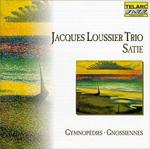 Satie: Gymnopedies Gnossiennes — Jacques Loussier List Price: $18.98
Do not be fooled by the record jacket! This is jazz. This album is my cool, soft jazz pick for today. Jacques Loussier may not be all that well-known to you, but in the music world, he is legendary.
He was born in France in the mid 1930’s and was a piano prodigy by the age of ten. In the late 1950’s Loussier decided that he could make a splash on the international scene by combining jazz music with classical (unheard of at the time) and it was a smash success.
 In fifteen years, the Jacques Loussier trio sold over six million albums. He was so influential to rock music and its innovators that he also hosted musicians in his studio in Nice, France. Among the more famous include Pink Floyd, Elton John, Sting and Yes.
Well, that’s all for this edition of Cool & Strange Music. I suppose these great CDs ought to keep you busy until next time. Don’t forget that Christmas is right around the corner and with gas prices going up like they are (you just know that gas will not be cheaper in November) it’s a good idea and smart to get at least some of your shopping out of the way.  Don’t forget that if you order over $25 of items at once, you are eligible for free shipping. So what are you waiting for? Be cool and save money now.
The Best of Mike (in Tokyo) Rogers
 Conservative Central Planning