


How To Help Low-Wage Workers (Without Raising the Minimum Wage)
by James Ostrowski by James Ostrowski
This article was originally published by Free New York as Policy Report No. 5.
The minimum wage law is in the news again, largely because the Democrats have misinterpreted the election as something other than a protest against the Iraq War and one-party rule.
Why do politicians love to propose increases in the minimum wage?
- It costs them nothing other than the ink and paper the bill is printed on.
- The vast majority of the law’s supporters simply do not understand the technical economic reasons why the law fails to help the working poor.
- Many people do not understand what the law actually means.
- Powerful special interests favor the minimum wage for reasons unrelated to the welfare of low-wage workers.
- The minimum wage promises to give us something for nothing.
What the Law Actually Means
A minimum wage law does not force an employer to hire or retain a worker at the minimum wage. In responding to a rate increase, the employer is perfectly free to fire any worker paid less than the new minimum wage and is certainly free to abstain from hiring new workers at the new minimum wage. Because many employers initially do in fact choose to raise wages instead of laying people off, we lose sight of the fact that this is purely at the employer’s discretion. Thus, the stated aim of the law is only achieved at the option of the employer whose hands the law sought to tie in the first place. The employer retains the option of hiring workers or retaining workers and paying them the increased wage, or firing them and replacing them with a smaller number of more highly paid workers and/or replacing workers with technology. The "greedy" capitalist gets the last move.
Thus, we might call this policy the optional minimum wage law to more realistically describe its legal impact. On the other hand, the law absolutely forbids the employment of workers at less than the minimum wage. There is no option there. Thus, again in the interest of using more accurate terminology, we could call the law a mandatory unemployment law. If the employer deems a worker’s productivity to be less than the newly required wage, and chooses not to retain that worker for purely sentimental reasons, it is mandatory that that worker be fired.
The Minimum Wage Law Causes Unemployment
This discussion of the legal ramifications of the minimum wage laws leads directly to an economic analysis of the law. The law will cause all those workers whose productivity falls below the new wage rate to be fired. Keep in mind that raising the minimum wage imposes new costs on the employer for Social Security, unemployment insurance and other costs. All these costs and not just the marginal wage increase will be considered by the employer in determining whether and which workers to fire. Also, it is a mistake to assume that merely because a certain worker is retained under the new law, that such retention will be permanent. The sudden firing of a worker can cause disruption that outweighs the marginal lost profits from temporarily keeping a worker who produces less gross revenue than he or she is paid. Rather, the true effects of the law are best seen in the longer term. For example, where have all the theater ushers gone? They were not all fired at once but gradually disappeared as it became more expensive to hire them.
There are studies that purport to disprove with statistics what economic logic tells us: the minimum wage causes unemployment. One study concluded that employment in fast food restaurants increased when the minimum wage increased. However, all economic logic says is that, all things being equal, the minimum wage will cause unemployment, or to put it differently, the minimum wage will lead to a situation in which fewer people are employed than if there was no minimum wage. Thus, we can say that, in the example cited, without the minimum wage, employment would have grown even faster. It is also true that an empirical study that showed that employment rose when the minimum wage was repealed would not definitely prove the theory because employment might have risen for some other reason!
Economic logic tells us that the minimum wage causes unemployment compared to economies without a minimum wage. In the real world, there are so many variables that affect the level of employment that no empirical study can definitely disprove our thesis. Without veering into the complex subject of the methodology of economics, suffice it to say that we use economic theory to explain real world experience, not the reverse.
Tragically, those priced out of the labor markets by the minimum wage are often young, unskilled, high school drop-outs, or minorities. Those who most need that first unskilled, low-wage job are most likely to be economically and legally unemployable after the wage rate is raised.
Thus, the first obvious effect of the minimum wage is to cause unemployment among the least skilled and most disadvantaged workers!
Can’t employers keep such workers on the payroll and simply shift the cost to their customers in the form of higher prices? Economist Walter Block says no:
It is my view that in equilibrium nothing will be shifted onto consumers. Instead, what will happen is that those whose marginal revenue product (MRP) (productivity) falls below the new minimum wage level will simply no longer be employed.
The only additional costs will not be those of paying someone more than his MRP. For example, paying $7.00 per hour to someone who is only worth $6.00. (At a minimum wage of $5.15 such a person could be employed. But at $6.00 MRP, he can no longer be employed, in equilibrium.) No, the only costs will be rearranging things so that there is now a greater demand for a few people with higher productivity, say $10 per hour (and more sophisticated capital equipment) to take the place of all those whose productivity falls into the range $5.15—$7.00. These people, like our guy with MPR = $6, can no longer work. This disruption is costly.
Other Costs of the Minimum Wage Law
There are other effects. As Economist Joseph Salerno has argued, with fewer people working, overall wealth declines:
First, since fewer laborers are now employed, aggregate production will be reduced and overall prices will rise, driving down real wages and incomes of consumers. Second, and perhaps more importantly, the allocation of resources will be distorted and production diverted from the most efficient service to consumer demands by what Walter Block calls “the costs of rearranging things.” Distortions of the allocation of capital goods from higher- to lower-valued uses were visible in the postwar years when increases in the minimum wage drove urban real estate owners to (prematurely) fire elevator operators and replace manually operated elevators with automatic elevators built, installed and serviced by skilled union laborers and to fire movie ushers and replace them with automatic lighting, again installed and serviced by union workers. Consumers suffered because the scarce capital required for this automation was prematurely and uneconomically withdrawn from higher-valued uses.
What happens to the unemployed? They do not simply vanish. They must survive somehow. Not being gainfully employed, they live off the generosity of family and friends, secure public assistance, beg, work in the black market or become common criminals. They become burdens on society. If they become criminals, they become a severe burden on society, far beyond their cost of daily living.
Thus, the minimum wage law has these effects:
- causes unemployment among the least productive workers;
- reduces wealth, causing prices to rise (same amount of money chasing fewer goods and services causes prices to rise)
- causes premature replacement of workers with technology, which again, reduces wealth and causes prices to rise.
- raises the cost of living for all
- increases the ranks of criminals and black market workers such as drug dealers with all the attendant social costs.
If the minimum wage law does not cause unemployment and can raise living standards at zero cost, why keep it so low? Why not have a minimum wage of $50 an hour? That way, we can all be upper middle class. The answer is that it would cause mass unemployment because most people aren’t worth $50 an hour. It would cause a mass exodus of workers into the underground economy and black market where government regulations by definition are ignored. The logic is clear and all skeptics have to do is realize that the negative effects of a huge rise in the minimum wage are also seen with smaller rises in the minimum wage but merely to a lesser extent. Why incur any of these unnecessary and destructive consequences of a bad policy?
Just Another Special Interest Law
It is not well known that the minimum wage law is and has always been a policy advocated by special interest groups for their own selfish reasons and at the expense of the general interest. Labor unions, few of whose members make the minimum wage, have always been strong proponents. The minimum wage sets a floor against which they can begin negotiations for union wages. It also eliminates competition from lower-skilled workers. Since unions have a long history of battling competition from racial minorities, it is no surprise that they continue to support a policy which generates enormous unemployment among minorities today.
Consider this disturbing report from the New York Times:
Black men in the United States face a far more dire situation than is portrayed by common employment and education statistics, a flurry of new scholarly studies warn, and it has worsened in recent years even as an economic boom and a welfare overhaul have brought gains to black women and other groups.
Focusing more closely than ever on the life patterns of young black men, the new studies, by experts at Columbia, Princeton, Harvard and other institutions, show that the huge pool of poorly educated black men are becoming ever more disconnected from the mainstream society, and to a far greater degree than comparable white or Hispanic men.
Especially in the country’s inner cities, the studies show, finishing high school is the exception, legal work is scarcer than ever and prison is almost routine, with incarceration rates climbing for blacks even as urban crime rates have declined.
Although the problems afflicting poor black men have been known for decades, the new data paint a more extensive and sobering picture of the challenges they face.
These were among the recent findings:
The share of young black men without jobs has climbed relentlessly, with only a slight pause during the economic peak of the late 1990’s. In 2000, 65 percent of black male high school dropouts in their 20’s were jobless — that is, unable to find work, not seeking it or incarcerated. By 2004, the share had grown to 72 percent, compared with 34 percent of white and 19 percent of Hispanic dropouts. Even when high school graduates were included, half of black men in their 20’s were jobless in 2004, up from 46 percent in 2000. (Emphasis added.) [Erik Eckholm, "Plight Deepens for Black Men, Studies Warn," March 20, 2006]
Unions aren’t the only special interest group that has benefited from the minimum wage. James Bovard writes:
The original minimum-wage law was enacted in part to decrease the advantage that low-wage southern factories had over northern factories; Rep. John Dent of Pennsylvania later explained: “We had to do something; we were losing all of our jobs to the south.” The new wage law devastated Puerto Rico; as economist Benjamin Anderson noted, “Immense unemployment resulted there through the sheer inability of important industries to pay the 25 cents an hour.”
What Determines Wages
Won’t greedy employers "exploit" workers and pay them starvation wages in the absence of a minimum wage law? This argument is self-defeating. It assumes that employers are motivated by self-interest, yet denies that selfish employers won’t bid underpaid workers away from other businesses. That is in fact what happens. If a worker who can produce $25 in gross revenue per hour for an employer, is only being paid $15 per hour, another employer will be willing to pay more. This bidding war will continue upwards to the $25 level. Employees will tend in the free market to be paid their marginal revenue product:
In labor markets, competition among entrepreneurs assures that there is a close association between worker compensation and the marginal productivity of labor. More precisely, compensation is determined by the workers’ “marginal revenue product,” which is the multiple of marginal physical product — how many physical goods or services the worker produces in a given time period — and the final price paid by consumers for those articles. [Thomas DiLorenzo]
As the theory of marginal revenue product would predict, the vast majority of workers are paid more than the minimum wage. This would not be the case if the self-interest of employers was the sole factor in determining wages.
How to Help the Working Poor
If the minimum wage law is bad for low-wage workers and the rest of society, how can we improve the welfare of the working poor? We can help the working poor in three ways:
- reduce their taxes
- reduce their cost of living
- increase capital investment
Reducing their taxes. We have seen that raising the minimum wage does not help the poor worker. It produces no new wealth and causes unemployment. While it does impose costs on employers, low-wage workers are not by and large the beneficiaries of such new expenditures. Employers respond by hiring a greater number of more highly skilled workers with greater productivity and by investing in more labor-saving technology.
The losers are:
- employers
- unskilled workers
- consumers
The winners are:
- more highly skilled workers
- producers and sellers of labor-saving technology.
In sharp contrast, lowering taxes on workers directly and indirectly raises their standard of living. Low-income workers pay a myriad of taxes, directly or indirectly. They directly pay income taxes, payroll taxes and sales taxes. If they rent, they indirectly pay property taxes. They indirectly pay for tariffs on imported goods. The best way to help the working poor is to allow them to keep more of the money they earn by cutting taxes.
Reduce their cost of living. The working poor spend a great deal of their income on the necessities: food, clothing, shelter and transportation. Various government policies including heavy taxation increase the cost of these necessities. If we can alter such policies and reduce those costs, we improve the living standards of the working poor. For example, government regulation of mass transit results in inefficient and expensive taxi, bus and transit monopolies. Trade policies that restrict importation of foreign food and clothing hurt the working poor by forcing them to purchase more expensive domestic products.
Increase capital investment. Wages are based on productivity which in turn is based on capital investment. The more capital investment employers make, the more productive their workers become and the more they can be paid. Numerous taxes and regulations directly and indirectly hinder or destroy capital investment. This ultimately harms workers. Here are some examples of taxes that hinder capital investment:
- corporate income tax
- capital gains tax
- individual income tax
- inheritance tax
Lowering these taxes will allow for more capital investment leading to greater productivity which will raise wages.
One of Free New York’s tenets is that you can’t cut taxes without cutting spending. In prior studies, Free New York has proposed numerous budget cuts, large and small and we will continue to recommend specific spending cuts in the coming months.
Conclusion
There’s an old saying: You can’t cheat an honest man. An honest man knows you can’t get something for nothing. It must be a con. Such is the minimum wage. It promises to give us something — increased wealth for low-wage workers, for nothing — the stroke of a pen in Washington, D.C. The world doesn’t work that way.
 If we really want to help the working poor, we have to pay the price. We have to do the hard work required to understand how to help them. Then, we have to make the hard policy changes required to improve their lot in life.
November 23, 2006
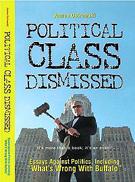
James Ostrowski is an attorney in Buffalo, New York and author of Political Class Dismissed: Essays Against Politics, Including "What’s Wrong With Buffalo." See his website.

