


What Would a Libertarian Supreme Court Justice Look Like?
by James Ostrowski by James Ostrowski
[Below are my prepared remarks as a panelist at a University at Buffalo Law School Federalist Society program on the recent Supreme Court nominations. I spoke last after a very liberal law professor and a conservative constitutional law professor. In her remarks, the liberal professor had summed up her position: "We believe in the federal government." I responded, speaking for many or most libertarians: "We don’t." I reminded the probably left-wing audience that it is the liberals’ beloved federal government that is fighting the war they oppose in Iraq. I asked, while liberals say that when states violate rights, the federal government should step in, where do we go when the federal government violates our rights, the United Nations? I never got a response, nor did I get a response the last time I asked that question.
 The conservative professor quoted Justice Scalia who, in response to those who believe in a "living constitution," said "the constitution’s dead; it’s parchment." I said, while that quip is quite amusing, I believe the constitution is dead for reasons Scalia would probably not accept. The framers had rejected a provision that would have allowed the federal government to use force against recalcitrant states. Thus, the voluntary nature of the union was an important check on centralized power for many decades. This understanding was, however, destroyed in 1861. Secondly, while Madison had argued that the militia system served as another powerful check on federal power, that system is also dead, being replaced by a permanent and enormous standing army. Yes, the original constitution is indeed dead!
Finally, the liberal professor complained about "corporate power." I said, I had never received a tax bill from a corporation. She cleverly said, I had, in the indirect form of special tax breaks for corporations. I responded, if the New Deal court she was so vociferously defending had not eviscerated the equal protection clause, such nonsense as corporate welfare would have been stricken down long ago.]
What would a libertarian Supreme Court Justice look like? That’s a very difficult question to answer without exhuming the bodies of Grover Cleveland’s appointees.
The constitutional philosophy of a libertarian would most likely be Jeffersonian. Jefferson hasn’t been a force in American politics since Cleveland left office in 1897.
On top of that is the problem that libertarianism is now a more hard-core doctrine than it was in Jefferson’s or Cleveland’s time. How do you combine the modern doctrine of libertarianism with the small "r" republicanism of Jefferson? There’s no easy answer to that question.
Two more problems: The Jeffersonian republic dies in 1861 when federal troops invade Virginia, ushering in an era of federal supremacy that continues to this day and is inconsistent with Jefferson’s vision.
 I’m afraid the problems are even deeper and older than that. The philosophical ancestors of libertarians were not too happy about the constitution in the first place and would have been happy with the old Articles of Confederation. They were the Anti-Federalists of their day.
So, how would a libertarian justice wrestle with the constitution that replaced the idyllic Articles and was massively bolstered by the Consolidation of 1861?
Years ago, I read about a study that analyzed a conservative justice’s judicial opinions. It found that he tended to favor the government over the individual and the federal government over state governments.
So what would a libertarian justice’s tendencies be?
- A libertarian would tend to favor the individual in any conflict with the government. As Jefferson wrote, "To secure these rights, governments are instituted." Governments serve us, not the other way around.
- A libertarian would tend to favor state governments over the federal government. As James Madison said, summing up the American structure of government: “The powers delegated…to the federal government are few and defined."
- And a libertarian would tend to favor the legislature over the executive at any level of government. As James Madison wrote in Federalist 51 regarding the ability of each branch to defend itself from actions by the others, “But it is not possible to give to each department an equal power of self-defense. In republican government, the legislative authority necessarily predominates.”
Philosophical Tendencies of Potential Judges
`
Individual v. Government (civil liberties)
Individual v. Government (economic issues)
Federal Government v. States
President v. Congress
Liberal
I
G
F
?
Conservative
G
I
?
?
Libertarian
I
I
S
C
Another way of looking at it is this. When dealing with constitutional provisions that speak of government power, the libertarian would be a strict constructionist. For example, the powers of Congress under the commerce clause would be construed narrowly. However, when dealing with provisions defining individual rights, the libertarian would be a loose constructionist.
Clearly, there hasn’t been a libertarian justice in my lifetime. The most libertarian current justice, in my view, is Clarence Thomas, but keep in mind that I say that based on a narrow range of opinions on a small number of issues. Specifically, he would narrowly construe the federal government’s power under the commerce clause and thus increase individual liberty. He would, if given the chance, defend the individual’s right to bear arms, which is clearly the point of the Second Amendment. And he would favor the states over the federal government in their intra-governmental disputes as in the term limits case. I can’t vouch for his libertarian views on other issues and they may be sparse. S till, libertarian views are so infrequently voiced on the Supreme Court that we greatly appreciate it when they are.
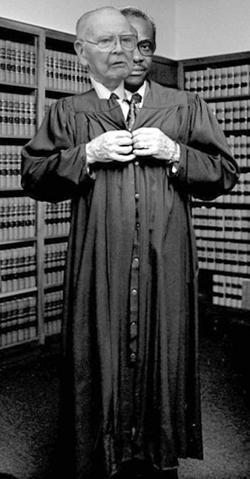
So what would a libertarian justice look like? See the picture to the right, but that radical fellow could never get nominated today.
 December 5, 2005
James Ostrowski is an attorney in Buffalo, New York and author of Political Class Dismissed: Essays Against Politics, Including "What’s Wrong With Buffalo." See his website.

