


 Since at least the mid-1960s, our national government has utilized a proven formula for the promotion of American wars around the world. It includes such practices as demonizing the enemy, proclaiming the selflessness of American motives and, when necessary, disseminating inaccurate information. The formula also involves the use of propaganda phrases ranging from "our enemy is a modern day Hitler" to "this is about human rights" and "the Pentagon fights wars as humanely as possible."
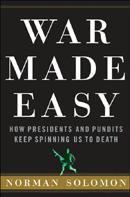
In his revealing new book, War Made Easy, Norman Solomon documents the misdeeds and lies that have led the United States into wars over the last five or six decades. Solomon, a noted political and media critic, also provides us with useful guidelines to distinguish propaganda elements that have consistently been used to convince the American people to support and sustain our nation's war-making efforts.
The following is a list (comprised of many titles of the book's chapters) of arguments that we can nearly always expect to hear each time the drums for war begin to be beaten in our nation's capitol:
- America is a Fair and Noble Superpower
- Our Leaders Will Do Everything They Can to Avoid War
- Our Leaders Would Never Tell Us Outright Lies
- They Are the Aggressors, Not Us
- Opposing the War Means Siding with the Enemy
- This Is a Necessary Battle in the War on Terrorism
- Our Soldiers Are Heroes, Theirs Are Inhumane
- America Needs the Resolve to Kick the "Vietnam Syndrome"
- Withdrawal Would Cripple U.S. Credibility
War Made Easy also discusses the things we are not likely to see when the clouds of war begin to gather. These include the reality that the last parties who will tell us that a war is wrong are members of Congress and most elements of the major media in our country.
Solomon's book is filled with accurate analysis and many quotes that are right on the money. One of his most important insights deals with the fact that after Harry Truman took the U.S. into the Korean conflict, every American military misadventure since has been driven by the desires of our presidents to wage war for their own purposes under our nation's flag and in our names.
In the book's prologue the author puts it this way, "Intense public controversy may precede the onset of warfare, but the modern historical record is clear: No matter what the Constitution says, in actual practice the president has the whip hand when it comes to military deployments – and if a president really wants a war, he'll get one…When the president of the United States is determined to go to war, a vast array of leverage and public-relations acumen can and will be brought to bear."
Many of Solomon's anecdotal quotes are quite chilling. For example, on April 25, 1972 the White House taping system recorded the following conversation between Ron Ziegler, Henry Kissinger and Richard Nixon:
Nixon: "How many did we kill in Laos?"
Ziegler: "Maybe ten thousand – fifteen?"
Kissinger: In the Laotian thing, we killed about ten, fifteen…"
Nixon: "See, the attack in the North that we have in mind…power plants, whatever's left – petroleum, the docks…And I still think we ought to take the dikes out now. Will that drown people?"
Kissinger: "About two hundred thousand people."
Nixon: "No, no, no…I'd rather use the nuclear bomb. Have you got that, Henry?"
Kissinger: "That, I think, would just be too much."
Nixon: "The nuclear bomb, does that bother you?…I just want you to think big, Henry, for Christsakes."
Later in his book, Solomon quotes ABC's Nightline reporter, John Donovan, on what he saw in Iraq two years ago as a "non-imbedded" reporter where he observed, "the close-up view of collateral damage. The U.S. says it's trying to limit injuries to civilians. It is, however, hard not to take it personally when that collateral damage is you." Donovan then reported on a wounded Iraqi man who had just lost his wife during the war, "She was collateral damage. So were his two brothers. So were his two children."
Finally, Solomon reprints the following story that first appeared in the National Journal: "On April 19, 2003, a little girl walked out of a crowd in Baghdad carrying a steel gray canister attached to a white ribbon. U.S. troops had left the canister behind in her part of town, and she was trying to return it to the American soldiers then on patrol. Sgt. Troy Jenkins, 25, a big man with blue eyes, recognized the child's gift as a cluster bomblet, one of the hundreds of thousands left dotting the country, and he threw himself onto it as the explosion began. When the dying was over a family in California had lost its father and a family in Iraq had lost its daughter."
This story appears in the book's fourteenth chapter, "The Pentagon Fights Wars as Humanely as Possible." Solomon follows up this passage with a discussion of the more than two million cluster bomblets dropped (so far) on Iraq. He states that at least "300,000 tiny bombs…(duds)…are waiting" for children, farmers and other innocent Iraqis to "nudge them the wrong way" tomorrow or ten years from tomorrow.
As concerned American citizens we must do all we can to expose the war on Iraq for that it always has been. Along with Cindy Sheehan, we must ask the question, "Who will be the last person killed for a lie?"
But we must also work to not allow "wars to be made easy" to conduct in the future. One of the best ways to begin such an effort is to read Norman Solomon's important and useful new book.
August 19, 2005

