


In September of 2002, after enduring a terrifying police helicopter raid on my home that lasted for an hour, ground troops equipped with large guns and ion-scanning equipment (but, oddly enough, not uniforms or a warrant) were deployed onto my property. The fateful day that delivered this horrific intrusion into my family's personal life prompted me to become involved in the effort to reform United States drug policy.
 A coca field in Putumayo, Colombia
The airborne drug raid team that terrorized my family – comprised of officers from the Tallapoosa County Sheriff's Department, the Alexander City Police Department, the Tallapoosa County Narcotics Task Force, the Alabama Bureau of Investigation, the Drug Enforcement Administration, the New Site Police Department, the Marijuana Eradication Project, and the National Guard – was on a special quest. But they weren't seeking a bomb-toting terrorist. Or a murderer. Or a kidnapper, rapist, thief, pedophile, or arsonist. Instead, they were looking for…marijuana, an herb as natural and benign as the oaks and pines growing in my back yard.
Had marijuana been found on my property, I would have been arrested, jailed, taken before a judge, likely found guilty (regardless of my actual fault), and suffered the seizure of my property and children.
But no marijuana was found that fateful day. Because I simply wasn't growing any. In fact, I never have. The raid angered and drove me to opine my observations and frustration in the Birmingham News, a local newspaper. I simply wrote that Alabama needed to reform its marijuana laws. I was guilty of nothing more than exercising my First Amendment right to free speech. Apparently these "inalienable" rights, like a national marketing effort, are "void where prohibited."
 Colombian children standing in a fumigated field
Six days later, I returned home to find officers of the Tallapoosa County Sheriff's Department, the Alex City Police Department, the News Site Police Department, and the Tallapoosa County Narcotics Task Force inside my house. They possessed a warrant based on the abovementioned newspaper opinion letter. More significantly, they claimed to find 0.87 grams of marijuana. I was arrested, jailed, and hauled before a judge – who found me guilty. Department of Human Resources workers, otherwise known as "government-sanctioned kidnappers," tried to seize my children.
The drug war is obviously inflicting serious and negative consequences in the United States. As horrific as was my family's experience, however, it pales in comparison to the drug war being exported to other nations by the United States. I learned this firsthand during the summer of 2004 when I traveled to Colombia, South America. As a Witness for Peace delegate, I studied first-hand the effects of the foreign arm of the U.S. War on Drugs.
 Fumigated House in Putumayo
I spent five days in one of the most dangerous parts of Colombia: Putumayo. At one time, the majority of the world's coca was grown in this region. Putumayo has been the main target of the fumigation effort of the U.S. Federal Government's Plan Colombia.
Plan Colombia, like the brutal tactics of the police in Alabama, involves aerial drug raids.
In Putumayo, however, whenever a drug warrior pilot "thinks" he sees an offending plant, he pushes a button, effortlessly raining chemical hell onto families, homes, food crops, schoolhouses, livestock, water, and land. The mainstream media doesn't report, however, that many times these pilots miss their intended targets. Plan Colombia destroys the livelihood of people whose only crime is poverty.
People in the Colombian countryside subsistence farm to provide for their families. Women still beat the dirt out of their laundry with rocks along creek banks. Life in Putumayo is still very primitive. By modern standards, it is a harsh existence.
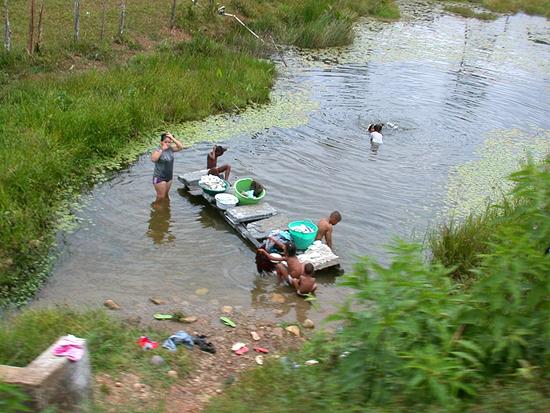 Woman washing laundry
The Putumayo scenery is absolutely gorgeous. Flora of every imaginable variety grows in soil so rich and dark, it appears to be permeated with ink. Majestic emerald mountains, extensive rivers and streams, a profusion of fabulously colorful birds decorating the skies, and the Amazon rainforest compose a breathtaking landscape.
Putumayo features one main road, paved in some places, but comprised of dirt and river rock in most. Narrow dirt paths branch off from the road, leading into the jungle and connecting the communities that somehow exist there. Infrastructure, for all practical purposes, is nonexistent.
 Giant Hibiscus Tree in Putumayo
The natural beauty of Putumayo rivals that of the Biblical Garden of Eden. I could easily imagine myself with a machete, carving out my own patch in the jungle, erecting a small wooden hut, and living out the rest of my days in paradise, growing pot plants 50 feet tall.
But my fantasy is rudely interrupted by the resident armed soldiers standing on every corner in the cities. A continual presence, they march up and down the country road in large groups.
My dream is further shattered by the large brown patches of dead, scorched earth that dot the otherwise glorious landscape, analogous to a massive malignant cancer on the Earth. A cancer that is, unfortunately, spreading and funded by your tax dollars.
Further fantasies are crushed by the ugly metal pipeline snaking across the jungle, pumping oil, marring the scenery, and polluting the environment. The pipeline is the target of frequent guerrilla attacks. It is so frequently attacked, in fact, that more oil has been spilled in Colombia than in the Exxon Valdez disaster in Alaska.
 Troops patrolling the streets
But no environmental clean-up teams work to protect the fragile and delicate ecosystems of Colombia. Instead, the brown cancerous patches on the landscape simply spread – and more and more food is poisoned. Something is terribly wrong in Paradise.
That something is U.S. foreign policy.
While I was traveling in Colombia, I met with various leaders and members of communities directly plagued by the poisonous aerial fumigation efforts of a foreign nation. The following quotes were obtained during those meetings.
Donde Cecilia, Camposino Union Leader: "We watched on TV when September 11th happened and we understood why it happened. We couldn't understand why Americans didn't."
Donde Ishmael, Camposino Union Leader:
"I am a farmer, not a criminal. What is the U.S. doing about demand for cocaine? We do not care about cocaine because it is not a part of our culture or religion. We grow it because it is the only crop that we can export and make enough money to care for our families. As long as there is a demand, there will always be a supply. The U.S. says they give us alternative development crops, but these are often fumigated. Even what escapes fumigation is worthless because there are no roads to transport it to the market."
Teachers in Valle De Guamuez:
 Once green vegetation, now brown and burned from fumigation
"The student population is directly affected by the violence. It is negatively affected when the national government sends fumigation planes to this region."
"Coincidently, the fumigations occur when children are attending school and sometimes when they are out for recess, in the fields."
"Some parents report that their children have been hit directly by the spray and it has caused them health problems."
"In March and May of 2004, the schools were fumigated."
"We had a school garden program where the children ate what they grew. It was very important because many of these children have had their food crops sprayed and their families cannot afford to feed them properly. The school garden was their only source of a balanced diet; for many, it was the day's only meal. It was destroyed by the fumigation."
"As the fumigations proliferate, most people simply move to more distant areas of the Amazon to produce coca. If the money being invested in fumigation was instead invested in infrastructure, people would return to legal agriculture. But there is no motivation to farm for profit because there are no roads to transport it. The crops get damaged on the rough roads along the way."
 Environmental damage resulting from oil pipeline attacks
"Many farmers end up joining one armed group or another because it is the only way they can survive. Their children often follow in their footsteps."
I also had the opportunity to meet with some advocates of Plan Colombia.
Lt. of the 22nd Colombian National Anti-Narcotics Brigade: "We do receive training from the U.S. All of the weapons and arms that we use are from the U.S. and we are trained in warfare tactics. We are not just police, we have become soldiers and are like military police. I believe everything I am told about Plan Colombia. The money goes where it is supposed to and there is monitoring and I am glad the U.S. is here. In my opinion, Plan Colombia has been working well and reaching its goals and I do not want the financing to end anytime soon."
The U.S. Embassy official in charge of Plan Colombia: Upon returning to Bogota, I had a meeting with U.S. Embassy officials. I specifically asked the drug policy questions and was not surprised by the answers I received from one official. I may have set him off when I introduced myself as follows.
"Hello, I'm Loretta Nall, a victim of U.S. drug policy and founder and President of the United States Marijuana Party. Thank you for having us today. If it is okay, I would like to ask you some questions."
Q: "A few weeks ago, U.S. Drug Czar John Walters took a fly-over tour of fumigated regions in Colombia. During a stopover in Mexico, he stated to the media that, despite all efforts, cocaine from Colombia remains readily available on U.S. streets and is purer and relatively unchanged in price. He said Plan Colombia had failed.
A few days later, he told a group of people in the U.S. that Plan Colombia was a success and that we would see a decline in purity and availability and an increase in price within twelve months. Can you please explain those discrepancies?"
A: He replied that he did not know the answer to my question.
Q: "In your introduction and overview, you admitted that coca farmers simply move the coca plants deeper into the Amazon Rainforest. Are there plans to fumigate the rainforest in an effort to eradicate the coca plant?"
A: The U.S. official went off on a tangent regarding how the coca farmers are defoliating the rainforest by planting coca there, but he didn't answer my question. When he finally stopped talking, I asked the same question again and he went off on a tangent about the farmers in Putumayo being a thorn in his side. He still did not answer my question. Thus, I repeated myself a third time.
Q: "I am asking you a simple yes or no question: do you have plans to fumigate the Amazon Rainforest when the farmers move their coca crops there? Will you please answer that question?"
A: "President Uribe has said we will spray wherever coca is."
Q: "So that is a yes then?"
A: "If coca moves into the Amazon Rainforest, we will spray."
Q: Next I asked him about the exit strategy and he went off on some rant and skated around some more. I had to repeat my question.
A: "When the National Police have a handle of the coca growing in Colombia, the U.S. will leave the country."
Q: "So what is the magic figure or number that will let you know the National Police have a handle on it?"
A: "There is no magic number."
Q: "So there is no exit strategy?"
A: "No."
Another member of the delegation asked, "What are the farmers who have given up growing coca supposed to do when the U.S. sprays their alternative development crops and refuses to reimburse them for the damage and loss? Where are they supposed to go? What were they supposed to eat?"
The Official responded, "Plan Colombia is a science and we do not make mistakes. The farmers who say they were wrongly fumigated are liars. These people have bigger extended families than anyone in the U.S. can imagine. When something happens to one of them, they can always go and live with Uncle Fred."
Thus, dear readers, I pose the following questions to you:
How can we allow poison to be dumped upon our neighbors in South America when we would not allow it to be dumped on ourselves or our neighbors across the street?
What does it say about America's true moral values that we allow – and indeed pay for – this to occur?
How can we claim that we are saving lives from Colombian cocaine when more people are killed in Colombia every year trying to keep cocaine out of the U.S. than die in the U.S. from Colombian cocaine?
According to U.S. Drug Czar John Walters, all of our efforts in stopping the flow of Colombian cocaine into the U.S. have failed miserably. Yet, Walters defended the Plan Colombia aid package, insisting that the effort should continue. "We have a history in the United States of not following through on programs like this," Mr. Walters stated.
Mr. Walters, perhaps there is a good reason that we do not follow through on "programs like this."
I learned much during my visit to Colombia. One fact that impressed me is that the tactics used in the U.S. drug war and those used in Colombia do not differ greatly in the results they produce. In Colombia, just as in the States, the people most likely to be negatively affected are the ones least likely to be able to afford to defend themselves. The ones with no means to fight back.
It is the same drug war that we experience here in America, only to a much worse degree. To truly understand the significance of this, one must understand that it is what we can expect here in the United States if the drug war escalation continues.
 However, the greatest thing I learned during my time in Colombia is why September 11th occurred. I learned that until the true Americans stand up and demand change in foreign policy, we will never again be safe in this country, nor do we really deserve to be.
Remember, you shall reap what you sow.
November 17, 2004

