


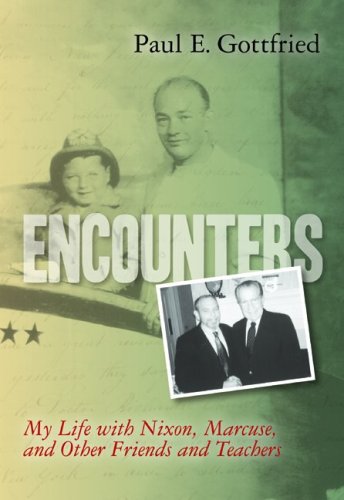
 Having very recently published an autobiography, Encounters, featuring famous and near-famous people I have known, two lessons came out of my writing experience. First of all, most of my figures, who had once been friends and mentors, like Murray Rothbard, Robert Nisbet and Eric von Kuehnelt-Leddihn, are no longer around and therefore hard to reproduce. These subjects live on in my selective memories or else in the pictures, books and letters they left behind. Although these personalities are put on display for the benefit of a later generation, posthumous depictions do not do full justice to any of them. For example, Murray Rothbard, as those who knew him and then read my book could testify, was a more vivid presence than the scholar I tried to bring to life from memory. Something else renders my depictions less than totally accurate. More than a bit of the biographer inevitably goes into what he does, and so it is not just the figure portrayed but the portraitist who shapes the image. Needless to say, there is a lot of me as well as those I evoke in Encounters.
Second, I am appalled by the animosity that movement conservative organizations and publications have exhibited in trying to black out my work. My book was meant to be a considered recollection of recent history in which all partisanship would be laid aside. Jeffrey Hart noted in a blurb that my work "would be indispensable for any future history of the conservative movement." Unlike my study two years ago, on the American conservative movement, which expresses a preference for Taft Republicans over Buckleyites and a fortiori neoconservatives, my autobiography is not explicitly polemical. Indeed my explanations as to why the neoconservatives and I have not been compatible avoid opening old wounds. I make a point of dealing only with figures I could write about sympathetically. This is not a work conceived to settle old scores.
 Encounters: My Life wi...
Best Price: $5.20
Buy New $5.60
(as of 08:10 UTC - Details)
Encounters: My Life wi...
Best Price: $5.20
Buy New $5.60
(as of 08:10 UTC - Details)

Yet the usual crowd is making sure that, like the four or five monographs bearing my name that preceded it, this book goes nowhere on the market. So far it has not been reviewed, nor is it likely that it ever will, in any of the outlets under liberal-neoconservative supervision (to make a distinction without a difference). Yesterday I received word that Heritage, despite repeated requests from the publisher, refused to schedule me as a speaker. Apparently this oracle of GOP intelligence has made it a policy not to allow speakers to address its staff on "autobiographical works," unless an exception must be made, as in the case of a tasteless Jewish comedian who recently spoke at Heritage about his conversion to a neoconservative foreign policy. This speaker had just published a work on the need for a neoconservative-directed government which Heritage was busily promoting. Presumably the volume in question was not an autobiography; otherwise the comedian would not have been allowed to speak to a full house of Heritage employees, who applauded him with all the gusto associated with the way Stalin’s underlings received his addresses at party congresses.


