


I, Alan Aurifericus Nefarious Greenspan, Chairman of the Federal Reserve Bank, holder of the Medal of Freedom, Knight of the British Empire, member of the French Legion of Honor, known to my peers as the "greatest central banker who ever lived," (I will not trouble you with all my titles. I will not mention, for example, that I was the winner of the prestigious Enron Prize for distinguished public service, awarded on November 1, 2001, just days after Enron began to collapse in a heap of corruption charges) am about to give you the strange history of my later years.
For I will dispense with childhood…even with young adulthood, and those dreary sessions with that terminally dreary woman, Ayn Rand, who couldn’t write a compelling sentence if her life depended on it. I’ll also dispense with my own dreary years at the Council of Economic Advisors, and pass directly to the time I spent as the most powerful man in the world. For here are my real titles: Emperor of the world’s most powerful money, despot of the world’s largest and most dynamic economy, and architect of the most audacious financial system this sorry globe has ever seen.
Yes, I, Alan Greenspan, ruled the financial world. But who ruled Alan Greenspan? Ah…I will come to that, and tell you how, while presiding over the biggest boom ever I became caught in what I may call the "golden predicament" from which I have never since become disentangled.
This is not by any means the first thing I have written. I have written much over the years. But it was all written for a purpose, which only a few were able to discern. Most readers foolishly saw the cluttered mind of a dithering economist or the clumsy, stuttering pen of a professional bureaucrat. Many listening to my wandering speeches and twisting sentences thought that English was not my first language. They thought they detected a faint accent, like that of Henry Kissinger or Michael Caine. They mocked me as "incomprehensible" or "indecipherable." They watched what they thought was an obsequious bureaucrat squirm. They had no idea what I was really up to and what I can only now reveal.
But they admired me, too. I knew it. Because they saw in me a kind of genius…a Bernoulli of banking…a Newton of numbers…a Leibnitz of lucre…a Copernicus of currency. My mind worked at such a high pitch, they believed, that my thoughts were inaudible to most humans. They counted on me to keep the great empire’s economy trundling forward. Little (actually nothing) did they know of my real thoughts and designs.
But now, all has changed. Now, I can write clearly and speak the truth. For now I am leaving my post. There is no further need for me to dissemble; no further need for me to pretend to kow-tow before Congressional committees; no further need to hide the real facts from my employers and the American people. Now, I swear by the gods, what I write comes from my own hand, and not from some overpaid, anonymous flack.
Some are born in crisis, some create crisis, and others have crisis thrust upon them.
Let me begin at the beginning. Scarcely had I settled into to the big chair at the Fed when a crisis was thrust upon me. And it is true, I responded in the conventional manner. There is no manual for central bankers, but there is a code of behavior. Faced with a financial crisis of any sort, a central banker’s first duty is to run to the monetary valves and open them. This I did in 1987. I was new to the job and probably didn’t open them enough. The U.S. economy lagged its rivals in Europe for several years. My old boss, George Bush, the elder, lost his bid for re-election in 1992 and blamed it on me. I resolved never to make that mistake again. Faced with a slew of challenges, shocks, uncertainties, crises and elections…ever thereafter, I made sure that every valve, throttle, level, switch and sluice gate was wide open.
But it was on December 5, 1996, that I had my first epiphany. That was the year that I made my celebrated remark about stock prices. I wondered aloud if they did not reflect a kind of "irrational exuberance." In truth, whether they did or did not, I do not know. But what I came to realize was this: 1) People, especially my employers, actually wanted prices that were irrationally exuberant. And 2) they could become far more irrationally exuberant if we put our minds to it.
I was 70 years old at the time. I had weaseled (why not be honest about it?) my way to the top post by knowing the right people and by making myself generally agreeable, and helpful, and by not saying anything anyone could disagree with. That was the original reason for what the press called "Greenspan speak." My private thoughts remained mine alone. All the public and the politicians got was gobbledygook, but for good reason.
They would not have wanted to hear what I really thought. So, I did not tell them. For I knew well and good what generally happened when politicians and central bankers got their hands on soft money and a compliant central banker. I was not born yesterday. They use their control of the money to cheat people. It is as simple as that. (I explained this early on in my career; fortunately, no one bothered to read what I wrote. Otherwise, I never would have gotten the job.) If central banking were an honest métier, there would be no reason to have it at all. Private banks could do the job better.
But people are ready to believe anything. Somehow, they think that a collection of rich financiers and power-mad politicians got together to create and run a central bank for the benefit of the people! Well, I’ve got news: it doesn’t work that way. Money is only valuable when it is rare. It is like stock in a company. The shareholder is happy to hold a few shares. But imagine how he would feel if the company issued a few million more shares. His own ownership of the valuable thing is diluted. He would be cheated.
Likewise, an honest banker cannot dilute his depositors’ money. He cannot create real money "out of thin air," as if he were issuing new share certificates, without cheating his clients. But that is exactly what central bankers do. They issue a certain amount of currency. Then, they issue more and more of it. So, the people who got it and saved it lose a little bit of the value each year. In effect, the value is lost by the savers and captured by the people who control the currency. It is really a very simple swindle. Who but an octogenarian Fed chief, on his way out the door, would have the courage to say so?
People today act as if they had invented money themselves. But money, central banking, and currency debasing have been around a long time. In 64 A.D., Nero decreed that the number of aureus coins minted from a pound of gold would increase from 41 to 45 (each coin would be about 10% less valuable). The silver denarius, meanwhile, lost 99.98% in the five centuries before the sacking of Rome. Paper sheds value even faster. The dollar has lost 95% of its purchasing power since the Fed was set up to protect it in 1913.
A successful central banker, in the age of compliant paper money, is one who is able to control the rate of ruin so that the rubes don’t catch on. A little bit of inflation, they believe, is actually healthy. Haven’t the economists told them so? Issuing a little bit more money each year makes people feel richer…so they spend more; they hire more people; they build more houses. Everybody is happy. Everyone feels richer. What an elegant fraud! It’s almost a perfect crime, because no one objects as long as it is done right. (My replacement at the Fed, Ben Bernanke, specializes in controlling the rate at which central bankers can steal from dollar holders without getting caught. He says that if necessary, he’ll "drop money from helicopters" should the currency fail to lose value fast enough. I predict that there will be a lot of people who will want to drop him from a helicopter…for reasons I will explain here.)
I return to my narrative. After I made my remark about "irrational exuberance," I was called into Congress. The politicians who confronted me were the usual oafs and know-nothings. They made it clear that if I wanted to hold onto my job, I would have to stop worrying whether asset prices were too high; instead, I would need to do all I could to goose them up! It was on that very day, I recall it well, that what I had previously seen only in foggy theory came out into the clear, bright daylight of applied central banking.
No one wants honest money. No one. The politicians, bankers, investors, voters, and householders — anyone with a voice in the matter wants "easy" money. It is just too delicious to resist. (I wondered what kind of a central banker would stand against them; he would need a backbone of titanium like Paul Volcker, and a head as thick and hard as a vault.) Debtors want a little inflation to lighten their burdens and put a wind to their backs. Creditors want inflation to swell their asset values. Politicians want to be re-elected. Businessmen want customers with money to throw around. Is there anyone who doesn’t appreciate a little inflation?
And yet, of course, I always knew the answer. Easy money only works by defrauding people into thinking they have more money than they really do. Easy come; easy go. They get it; they spend it. Before you know it, you have a boom. But people soon adjust their expectations. Prices rise to catch up to new money. Debt levels increase, and with them come heavier debt service costs. The magic fades. What can a central banker do? He can do the right thing. He can "take the punch bowl away," as my predecessors used to say. But this is where the trouble begins. Take away the punch bowl, and they begin punching you! I recall they burned Paul Volcker in effigy on the Capital steps when he did it. They would have burned him alive if they could have gotten their hands on him.
Why should I, Greenspan, suffer such a fate? No, it was not for me. This was the "golden predicament" I faced. Yes, I knew well that the nation would be better off if the punch bowl were removed, but I knew that I would be removed too, if I did it. And I knew, also, that it would be just a matter of time until the pressure for easy money would overwhelm any resistance a Fed chairman could put up. No pure paper money system has ever lasted. People can never resist the temptation to make the money easier and easier…until it is so wobbly and woozy it falls on its face. It’s better that it falls sooner rather than later. It’s better that the lesson is taught now, rather than 10 years from now. It’s better that the lean times come on the next man’s watch, not on mine! That’s what I owe to old Ayn; she taught me who rules Greenspan — Greenspan! Ayn taught me the number one rule: Look out for Numero Uno.
I remember it so clearly. I was sitting in a House committee hearing room. My tormentors kept asking questions. I kept giving the kind of answers for which I later became famous…answers that didn’t say anything. And I thought to myself: if these lardheads want easy money, I’ll give them easy money. I’ll give them the easiest money the planet has ever seen! I’ll give it to them good and hard!
And so, I did.
Since I joined the Fed, outstanding home-mortgage debt has jumped from $1.8 trillion to $8.2 trillion. Total consumer debt went from $2.7 trillion to $11 trillion. Household debt has quadrupled.
And government debt, too, exploded. The feds owed less than $2 trillion in the second Reagan administration, a figure that had been almost constant for the previous 40 years. But under my direction, the red ink has overflowed like the Nile in flood — to over $7 trillion.
During the two terms of George W. Bush alone, the feds have borrowed more money from foreign governments and banks than all other American administrations put together, from 1776 to 2000. And more debt will be added in the eight Bush years than in the previous two hundred. The trade deficit, too, more than tripled since I’ve been at the Fed, from 150.7 to 756.8 billion, and will reach $830 billion in 2006. When I came to power, the United States was still a creditor. Now, it is a debtor, with more than $11 trillion worth of U.S. assets in foreign hands, a more than 500% increase since 1987.
Who can argue with such a record? Who can compete with it? Who would want to?
But that is the smooth, perverse pleasure a cynical old man takes in his achievements. I have practically ruined the nation, and I know it. If you distributed the cost of the federal government’s programs, promises, and pledges to the voters, along with the nation’s private debt, the typical household, and the nation itself, would be broke. And yet, almost everywhere I go, I am revered as a maestro…saluted as if I were a war hero. It is as if I had won World War II all by myself. The same numbskulls that wanted easy money 10 years ago, now praise me for causing what they call "The Great Moderation," as if there were anything moderate about America’s borrowing binge.
 Others say that my real legacy is that I finally "made central banking work." Yes, I made it work…just like it’s supposed to work, giving the people enough rope so they could hang themselves. That’s what they’ve done. Now, they dangle from a long rope of mortgages, deficits and credit cards.
 And I am delighted. Soon, people will be able to see how central banking really works. And poor Ben Bernanke will get the blame for it. He and his stupid helicopters…he almost deserves it.
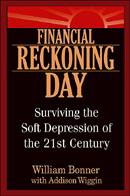
Bill Bonner [send him mail] is the author, with Addison Wiggin, of Financial Reckoning Day: Surviving the Soft Depression of The 21st Century and Empire of Debt: The Rise Of An Epic Financial Crisis.

