


“The picture Ortega y Gassett draws of the mass man is not an attractive or flattering one, but Ortega is not a snob who simply excoriates the appalling habits and tastes of those below him in the social scale. For him, mass man is the man who has no transcendent purpose in life, who lives in an eternal present moment which he wants to make pleasurable in a gross and sensual way, who thinks that ever-increasing consumption is the end of life, who goes from distraction to distraction, who is prey to absurd fashions, who never thinks deeply and who, above all, has a venomous dislike of any other way of living but his own, which he instinctively feels as a reproach.”
~ Theodore Dalrymple
 The national colors of the European nations are well represented on the faces and body parts of the spectators during major soccer games between the countries. During the 2006 World Cup games Germany was a spectacular host to the nations of the world featuring its new stadiums, brothels and high-tech entertainment in their country. It also sported, for the first time in decades, its national colors of black-red-gold with a renewed national pride.
National pride is something Germans had never really known in their history before the First World War. The many states that battled Napoleon during the Liberation Wars in 1813 called out to unite under one nation to reach a German national identity. Hitler managed to instill a perverted national pride in his countrymen due to the aftermath of World War I. This sort of national pride, as it was briefly displayed during the Nazi years, quickly ended with the horrific discoveries of death camps, Gestapo tactics, racial hatred and the lunacy of its political leaders. Since 1946 German national pride has never been publicly displayed in the way it is exhibited in the US or Great Britain.
Pride stems from a sense satisfaction that one receives through achievement, through possession or through being associated with the best of a group or class. It is within human nature to indulge in these little pleasures if not to find value and self-respect. An overindulgence of pride can change matters rather fast by exhibiting treatment of haughtiness and disdain toward others. It drains a lot of energy and resources to continually feed pride as its original meaning gets lost in the hunt to sustain this false sense of security.
National pride is a well-known trademark of Americans. In the past it has meant identification with a country that esteemed liberty for all, individual rights, personal ownership, private contracts between two individuals and the right to bear arms in defense of one’s property. It set this nation apart from the rest of Europe and the world by being the first of its kind, in a class to itself and capable of producing, achieving and possessing the best of the best. Or so it once was. These days the symbol of the state, the eagle, has, over time marked its territory again. It has been taken over by institutions and special interest groups that steal the people’s resources and pursue their own interests at all cost. Pride is now found in a collective state power and not in any earnest, personal accomplishments.
The eagle is an ancient symbol. The German coat of arms features a golden or yellow field (background) with a black eagle facing to its right with red beak and claws. It is one of the oldest state symbols in the world. Its roots go as far back as the Holy Roman Empire. The eagle itself reaches as far back as antiquity in which the eagle was thought to be a messenger of the gods. It symbolized Zeus in Greek mythology and Jupiter to the Romans. The eagle became a military symbol in that he also represented courage and strength and was displayed on the banners of military campaigns.
Charlemagne resurrected the symbol of the eagle in 800 AD as he rebuilt the Roman Empire. He placed a golden eagle on top of his palace in Aachen. The coat of arms as it now appears first surfaced during the 1400’s in the Codex Manesse featuring a picture of Heinrich VI. During the early years the eagle did not represent the state but more an idea of stately order as the Holy Roman Empire was above any national identity. Over the centuries it became entwined with state authority and became a symbol of liberty and later identified as a national symbol in surrounding nations.
The colors of red-white were one of the oldest identification of the Hanse towns (i.e. Hamburg, Bremen, Danzig) and were part of their city crests. The imperial colors of the many crests during the Holy Roman German Nation were reflected under black and gold and were used in most imperial cities or free cities. Legend even says that during the coronation of Friedrich Barbarossa in 1152, the red carpet on which he walked from the cathedral to the Romerplatz in Frankfurt was later divided amongst the citizens and waved as little flags.
The colors of black-red-gold did not reappear again until 1813 when the idea of a German national state became the thrust for liberty from the occupation of Napoleon. The Lützow Free Corps (Lützower Jäger), a voluntary unit of the Prussian Army during the Liberation War under the leadership of Ludwig Adolf Wilhelm von Lützow, featured red cuffs on their black civil frocks with gold buttons. Their volunteers received no pay and mostly included students, citizens of various German states, and foreigners who had armed themselves at their own expense. Many of their members had strong national leanings such as Friedrich Ludwig Jahn (founder of the national gymnastics club).
Although the black Sunday frock was the most uniform clothing item amongst the citizens and upper class alike, it became the basic color of the corps. Gold-colored brass buttons were easily available and their lance pennants were in red and black. Friedrich Förster, a captain in the corps with Eleonore Proschaska (one of the two women who joined the corp.), reported that he first saw the flag of black and red with golden fringes at the Dresdener Werbestube of the Lützower Jäger. Apparently the women of Berlin dedicated the flag made out of satin with the inscriptions "Mit Gott fürs Vaterland." Here it is noteworthy that its meaning of this phrase was entirely based on liberating and defending an occupied homeland by a foreign force under Napoleon. The flag was not used in battle, as the king prohibited the use of it.
In 1815 the tri-colors became integrated into the flag of the first student fraternity of Jena (Burschenschaft). Many of the students were once volunteers of the Lützow Free Corps. The idea of the students of Jena was to exemplify German unity and especially the "Virtues of the Nation." The fraternity chose the slogan of "Ehre, Freiheit, Vaterland" (honor, liberty, homeland). Their flag of red-black-red contained the symbol of a golden oak branch with golden fringes.
The German people were hoping for a country-wide constitution that would unite them in one nation. The process was slow, and the political hack-job done by the Vienna Congress in 1815 left many disillusioned. The dukedom of Sachsen-Weimar-Eisenach was one of the first states to receive a partial modern constitution that included the freedom of the press, liberties to express opinions publicly and the right to freely assemble. The German states were now under a loose confederacy that included thirty-nine states along with the kingdom of Prussia and Austria.
In October 1817 the student league of Jena invited prominent representatives of various universities and students all over Germany to come to Wartburg. The occasion marked the 300th anniversary of Martin Luther’s theses and the battle of Leipzig in 1813. The tone set by some of the professors who called for a unified education that would shed the provincial man and make ways for the new universal man. Lorenz Oken, doctor of medicine, came close to the idea of traveling and working freely throughout the country regardless of regional origin. He wanted to go beyond ones identity of being Bavarian, Franconian or Prussian. He failed to see that patriotism and tradition are culturally tied to one’s heritage and place of origin.
One of the visitors was Hans Ferdinand Massmann, under whose direction the students burned books and other items that symbolized their opposition. Among the things burned were the Code Napoleon, an Austrian corporal stick used for beatings, a Prussian uniform, works by Jewish author Saul Ascher, Russian writer August von Kotzebue History of the German Empire, Scherer Wadzecks works against the art of gymnastics, Carl Leberecht Immermann’s critique to the student league, and many more.
Even the German author Heinrich Heine was not pleased with the events that took place at the Wartburgfest. In 1840 he writes in one of his memoirs that "… on the Wartburg ruled a narrow Teutomanismus, one that cried of love and faith, but whose love was nothing but hatred toward that that is foreign, whose belief existed in irrationality, and in their ignorance knew nothing better to do than to burn books." Heinrich Heine was once quoted as saying "It was only foreplay, since where books are burned; people will be burned in the end." The quote was in reference to the burning of the Koran in one of his dramas called Almansor. A chilling reality indeed when irrationality becomes law.
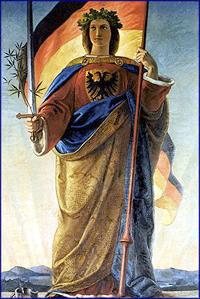
The mid-19th Century was filled with romanticism and ideals of nationalism. The romantic painter Phillip Veit featured one of his most famous paintings of Germania during the national assembly in the Paulskirche of Frankfurt on May 18, 1849. The ruling principalities agreed to an assembly after the March revolutions of 1848. The members of the representative committee of the ruling princes accepted the tri-colors in order to appease the people although they were one of the strongest opponents of the democratic movement. The colors became the decorative note of the assembly.
The national assembly itself consisted of reformers of various political associations. Amongst them were socialists, bourgeois left-wing republicans, liberals and conservatives (traditionalists) with the strongest representation coming from the center. About 585 members attended the meeting of which the majority had a high-school diploma. More than a fourth had a university degree. The bulk of the members were former members of a corps or fraternity. Many of the professionals were high-school teachers, professors, lawyers, judges, civil servants with few representatives of artisans and farmers. The assembly received the nickname Professorenparlament (parliament of professors) and became the most drawn out event in order to find a common ground for their constitution.
The demands made by the revolutionaries varied by association but the core idea presented five major categories: Freedom of the press, creation of a German parliament, right to arm local communities, the constitution and the creation of a national state. The many committees and endless disagreements eventually lead to very little. Although it is said that the assembly became a democratic role model for the modern constitution, it was little more than a futile process wanting to harmonize opposing ideas and beliefs. The moral principals that in spirit can unite many without losing one’s cultural identity got lost in the melting pot of streamlining the national state.
The German language in itself was not necessarily an agent of unity. The cultural, religious and regional language differences have always been apparent between the Prussian and Austrian empires. Although they were part of the German Confederacy, the Austro-Prussian war of 1866 finally settled the question of the German Union with Prussia becoming the imperial and military leadership of the new German nation. The colors symbolizing the revolution for democracy disappeared and gave away to the imperial colors of the German Kaiser. The pride of the nation was now festered in the state’s military power, educational system and a new welfare that took the form of protector and dispenser of social benefits.
The contrast between the German desire for a national constitution and the US Constitution is startling. The American colonies wanted a republic that had little to do with centralized federal authority over their individual states or personal lives. What united the Americans was not so much their language as it was their desire of self-governing their local regions under the protection of their Constitution. It was the absence of hundreds of politicians and academia that allowed the free citizens of their early states to go about their business. Starting out with only fifty-five state representatives, the US Constitution was formulated and birthed in 1787 by a small group of people that managed to understand the idea of liberty wasn’t granted by government but is an inherent God-given right.
It was from 1840 through 1900 that Germans began to migrate in large numbers to the United States. After the failed Revolution in 1848 over six million Germans alone settled in the new land prior to World War I and were known as the Forty-Eighters. It was one of the largest ethnic groups of immigrants and eventually came to make up seventeen percent of the population. They brought with them their own personal talents of craftsmanship, engineering and agriculture. But their ideology for a national state seemed to have finally been realized as many of them joined the Union during the War Between the States in 1861.
Germany’s national colors symbolized democracy with strong leaning toward both nationalism and socialism for all the various political fractions besides the aristocrats. After the defeat of World War I, the Weimar Republic returned to the use of black-red-gold colors as their national flag. Adolf Hitler’s national socialists preferred the use of black-white-red with the swastika becoming the addition to the eagle. In May 1949 Germany officially made the tri-colors their state flag as did the former East Germany. The tradition of the flag was to represent unity and freedom. It was to remind of freedom of ideas, the idea of personal freedom which is to be the basis of Germany’s future state.
Only how much freedom is to be realized by the individual when his desire to freely pursue his personal education comes under the guardianship of the state? How much freedom is there really available when a small business is taxed so that his neighbor is sponsored by public money to open another? The black hole of nationalization under the guise of federal power continues. The rights of the individual are eclipsed and abused. The more streamlining that is done to appease thousands of different special interest groups leaves less remaining to the private man.
 National colors are very appropriate for sporting events. One can cheer for their home team to win and be proud of their results or angered over their loss. The individual man disappears into the crowd and sways with the rhythm of the spectators. No special features of an individual are recognized as everyone hides behind their favorite color. Then, in a harmless way, he becomes mass man with no real distinction of his personal likes and tastes. Then he is safe for a few moments to forget the rich heritage of his own ancestors and sacrifices his personal freedom on the altar nationalism.

